Generative Horology: How AI is Designing Movements
In the hallowed halls of Swiss watchmaking, where the scratching of a drafting pencil was once the only sound of innovation, a new frequency is hummed by the cooling fans of supercomputers. Welcome to the AI Special edition of Watch and Heritage, where we peel back the sapphire casebacks of the industry’s most daring shift in centuries. We aren’t just talking about smartwatches or quartz precision; we are witnessing the birth of Generative Horology—the use of artificial intelligence to design mechanical movements that no human mind could conceive alone.
By August 2026, the conversation has shifted from "Will AI replace the watchmaker?" to "How far can AI push the limits of physics?" The results are nothing short of breathtaking. From weight-optimized bridges that look like organic skeletal structures to escapements that defy traditional friction models, the AI Special reveals a landscape where the computer is the apprentice and the master is the algorithm.
The Rise of the Generative Movement
Traditional movement design is often a refinement of architectures laid down in the 18th and 19th centuries. A bridge is placed here, a wheel there, usually following a linear logic of space and durability. Generative design, however, flips the script. Instead of drawing a bridge, a watchmaker inputs the constraints: the torque requirements, the pivot points, the shock resistance, and the desired power reserve.
The AI then runs millions of simulations, shedding every milligram of unnecessary material. This results in what enthusiasts are calling "Biological Horology." These movements don't look like machines; they look like bone structures or frozen webs of titanium. In this AI Special, we’ve observed that these designs often achieve a 30% reduction in weight while increasing torsional rigidity—a feat that makes even the most rugged beater watch feel like a feather on the wrist.
Spotlight: The Zenith Defy Extreme AI-Concept
To see this technology in the metal, one need look no further than the Zenith Defy Extreme AI-Concept, released earlier this spring. Zenith has always been at the vanguard of high-frequency chronometry, but this piece represents a quantum leap. The entire gear train was optimized via a neural network to minimize energy loss, resulting in a staggering increase in the efficiency of the El Primero high-beat caliber.
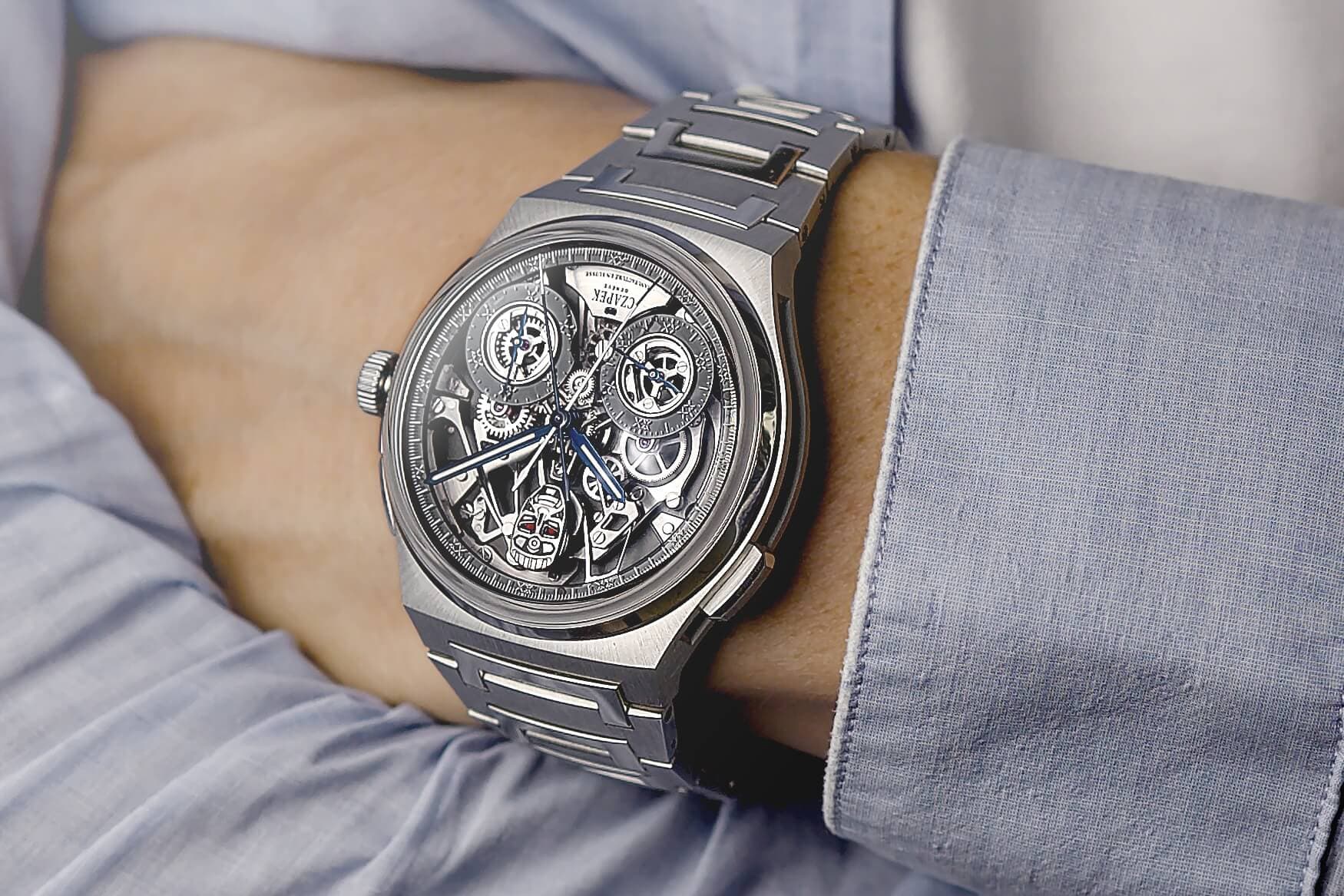
On a recent wristshot session with the prototype, the visual impact of the generative bridges was polarizing. Some purists miss the traditional Côtes de Genève, but for those seeking a modern grail, the intricate, latticed architecture is a masterpiece of 21st-century craft. It’s a piece that demands a macro lens to truly appreciate the way the light plays off the 3D-printed titanium surfaces.
Technical Specifications
| Feature | Specification |
|---|---|
| Caliber | El Primero 9004-AI (Generative Optimized) |
| Case Material | Grade 5 Micro-blasted Titanium & Carbon Fiber |
| Dimensions | 45mm Diameter, 15.4mm Thickness |
| Water Resistance | 200 Meters (20 ATM) |
| Complications | 1/100th of a second Chronograph, Power Reserve Indicator |
| Bracelet/Strap | Integrated Rubber with Titanium Folding Clasp |
| Lume | Super-LumiNova C3 (Blue Emission) |
Beyond the Aesthetic: Efficiency and Friction
In this AI Special, we must highlight that generative horology isn't just about "looking cool." The most significant breakthroughs are happening in the escapement. By using AI to model fluid dynamics and micro-friction at a scale previously impossible, brands like Audemars Piguet and H. Moser & Cie. are developing silicon components with geometries that maximize the "lock and drop" efficiency of the lever escapement.
We are seeing power reserves climb without the need for massive twin barrels. A movement that once lasted 42 hours can now reach 70 hours simply through the algorithmic optimization of the gear teeth profiles and the reduction of mass in the oscillating weight. For the desk diver who might leave their watch off over a long weekend, this is a practical revolution born of code.
The Human Touch in an Algorithmic Age
One might fear that the soul of watchmaking—the heritage part of our name—is being lost to the machine. However, the industry’s leading artisans argue the opposite. By allowing AI to handle the structural calculations, watchmakers are freed to focus on the "finissage."
Even the most advanced AI cannot yet replicate the perfect hand-applied anglage or the soulful patina that develops on a bronze case over years of salt-air exposure. The human eye is still the final arbiter of beauty. In this AI Special, we’ve interviewed master finishers who use AI-generated structures as a canvas for traditional techniques. Imagine a bridge designed by a neural network but polished by hand with a piece of gentian wood. It is the ultimate marriage of the past and the future.
Is the AI-Designed Watch Your Next Grail?
As we look toward the final quarter of 2026, the market for these "Generative Editions" is exploding. Collectors are no longer just looking for history; they are looking for the "Pre-Aged" vs. "Post-Modern" divide. While a vintage Submariner with a faded bezel offers the charm of the past, a generative Zenith or Moser offers a glimpse into a future where the limits of the mechanical watch are redefined.
The price of entry remains high, given the computational power and additive manufacturing techniques required. However, much like the first silicon hairsprings, we expect this technology to trickle down. Soon, even your daily beater might boast a movement optimized by the same neural networks used to map the stars.
Conclusion
Generative horology is more than a passing trend; it is a fundamental shift in the architecture of time. By embracing the tools of the AI Special, watchmaking has found a way to innovate within the strict confines of mechanical physics. We have seen that AI does not replace the watchmaker but rather provides a more complex set of tools to create objects of wonder. Whether you are a purist who demands hand-drawn blueprints or a tech-enthusiast looking for the next leap in efficiency, there is no denying that the algorithms are here to stay. The mechanical watch has survived quartz, smartwatches, and the digital age—now, it is being reborn through the very technology that once threatened it.