Return of the Neo-Vintage: Why the 1990s are Back
In the rapidly evolving landscape of horology, a new frontier is capturing the hearts of seasoned collectors and newcomers alike: neo-vintage watches. For years, the market was obsessed with 'true' vintage—the plexiglass-clad, radium-burned relics of the 1950s and 60s. But as prices for those pieces have ascended into the stratosphere, a discerning segment of the community has turned its gaze toward the 1990s. This era, once dismissed as the 'awkward teenage years' of watch design, is now being recognized as a golden era of proportion, soul, and technical transition.
What Defines the Neo-Vintage Era?
While the boundaries are often debated at local meetups over a few drinks, the consensus among experts is that the neo-vintage period spans roughly from the mid-1980s to the early 2000s. It was a time when the industry was emerging from the shadows of the Quartz Crisis, rediscovering its passion for mechanical excellence while embracing modern manufacturing tolerances.
Neo-vintage watches represent a 'sweet spot' in watchmaking. They often feature the classic proportions we love—think 36mm to 40mm cases—but come equipped with sapphire crystals that don't scratch at the mere sight of a door frame. Perhaps most importantly, many pieces from the early-to-mid 90s still utilized tritium for their lume. This radioactive material provides the one thing modern Super-LumiNova cannot: a natural, creamy patina that develops over time, giving each watch a unique fingerprint.
The Technical Bridge: Modernity Meets Heritage
One of the primary reasons collectors are flocking to this era is the sheer usability of the pieces. A watch from 1994 feels like a modern tool on the wrist, yet it carries the DNA of its ancestors. You get the 'clicky' reliability of a modern movement like the Rolex Caliber 3135 or the Omega Caliber 861, but often housed in a case that hasn't yet succumbed to the 'maxi' proportions of the late 2000s.
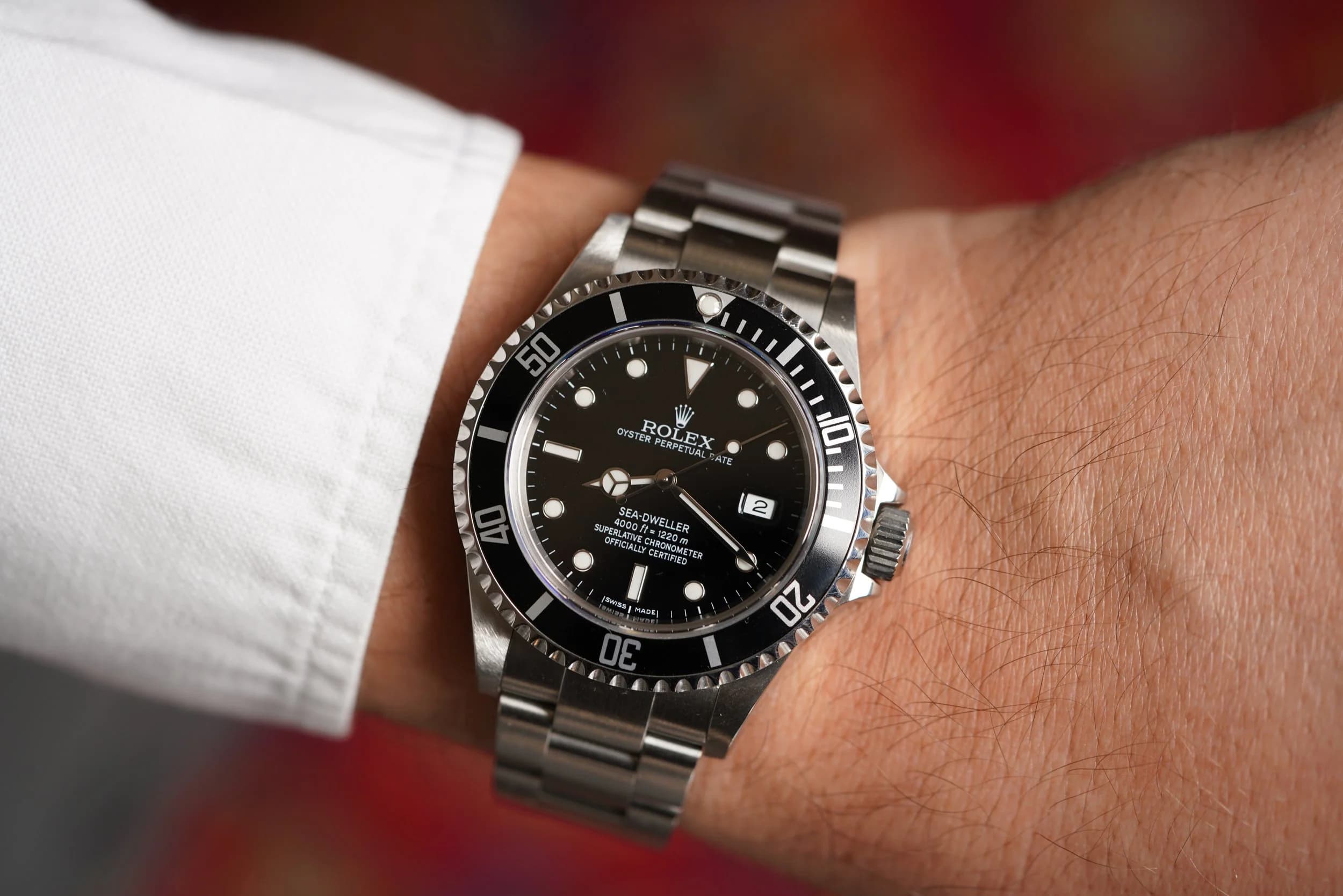
Take, for example, the Rolex Sea-Dweller Ref. 16600. Produced between 1989 and 2009, this reference is the quintessential neo-vintage diver. It possesses the iconic helium escape valve and a staggering depth rating, but it retains the slimmer lugs and drilled lug holes that make strap changes a breeze. For many, it is the ultimate 'desk diver' that can still handle a weekend at the coast without breaking a sweat.
Case Study: Rolex Sea-Dweller Ref. 16600
| Feature | Specification |
|---|---|
| Caliber | Rolex Manufacture 3135 (Automatic) |
| Case Material | 904L Stainless Steel |
| Dimensions | 40mm Diameter, 14.5mm Thickness |
| Water Resistance | 1,220 Meters (4,000 Feet) |
| Complications | Date, Helium Escape Valve |
| Bracelet/Strap | Oyster Bracelet (Ref. 93160) with Fliplock |
| Luminous Material | Tritium (pre-1998) / Super-LumiNova (post-1998) |
The Appeal of the 1990s Aesthetic
The 1990s were a time of experimentation. While brands like Rolex were refining their icons, others like IWC and Jaeger-LeCoultre were pushing the boundaries of what a mechanical watch could be. The IWC GST line, for instance, combined 'Gold, Steel, and Titanium,' resulting in some of the most avant-garde integrated bracelet designs of the decade.
Collectors are also rediscovering the 'hidden gems' of the era. The Omega Speedmaster 'Reduced' or the early sapphire-sandwich Moonwatches offer a different tactile experience than today’s versions. There is a certain charm to the slightly jingly bracelets and the printed dials that have started to fade into 'ghost' bezels or tropical browns. For the enthusiast who wants a 'grail' watch without the six-figure auction price of a 1950s Submariner, the 90s offer a playground of opportunity.
The Market Shift: Why Now?
As we look at the market in late 2021, the surge in interest for neo-vintage watches is driven by several factors. First is the 'Instagram effect.' As photos of beautifully aged 16710 GMT-Masters and 14270 Explorers flood our feeds, the collective eye has moved away from the bulkier modern silhouettes. There is a growing appreciation for the 'wristshot' that shows a watch fitting under a shirt cuff rather than dominating it.
Secondly, there is the factor of reliability. A 'true' vintage watch from the 1960s can be a finicky beast. Parts are scarce, and taking one near water is often a recipe for disaster. Neo-vintage pieces, however, can usually be serviced by the manufacturer or a competent independent watchmaker with relative ease. They are robust enough to be a daily 'beater' while still possessing that sought-after vintage soul.
Finding Your Neo-Vintage Piece
When hunting for a watch from this era, the 'Full Set' becomes increasingly important. Unlike the watches of the 60s, where boxes and papers were often tossed in the bin on the way home from the jeweler, 1990s owners were more likely to keep their documentation. Finding a 1995 Omega Seamaster 300M—the 'Bond Watch'—with its original red leather box and warranty card adds a layer of provenance that modern collectors crave.
Pay close attention to the dial. If you are looking for that classic patina, search for 'T<25' or 'T Swiss T' markings at the six o'clock position, indicating the use of tritium. These are the pieces that will continue to age gracefully, developing that warm, toasted marshmallow hue on the plots that Super-LumiNova simply cannot replicate.
Final Thoughts
The return of the neo-vintage era is more than just a passing trend; it is a correction of the market. We are finally recognizing that the 1990s produced some of the most wearable, durable, and aesthetically balanced timepieces in history. Whether it’s a rugged IWC Pilot or a refined Patek Philippe Calatrava from the era, these watches offer a connection to the past without the headaches of the distant past.
As we move toward 2022, expect the demand for these transitional pieces to only increase. They represent the last vestige of 'old school' watchmaking before the industry moved toward high-tech ceramics and silicon hairsprings. For the collector who values character as much as chronometric precision, the 1990s are truly back, and they have never looked better on the wrist.