Piaget Altiplano Concept: Thinness Title Reclaim
In the high-stakes arena of ultra-thin watchmaking, the battle for every tenth of a millimeter is fought with the intensity of a grand prix. For years, the Piaget Ultimate Concept has stood as a beacon of what is humanly possible when engineering meets artistry. Following the recent buzz from Watches & Wonders 2024, the Maison has once again silenced the skeptics. By integrating a peripheral tourbillon into a frame that remains a staggering 2mm thin, Piaget hasn't just participated in the 'thinness wars'—they have fundamentally rewritten the rules of the game, reclaiming their title as the masters of the ultra-thin complication.
The Genesis of the Piaget Ultimate Concept
To understand the magnitude of the current achievement, we must look back to 2018. When the first Piaget Ultimate Concept was unveiled as a prototype, many in the industry dismissed it as a 'concept' that would never see the light of day on a collector's wrist. It was too fragile, they said. Too experimental. Yet, by 2020, Piaget proved the doubters wrong by making it a commercially available reality.
The architecture was revolutionary: the case back served as the mainplate for the movement, and the crown was replaced by a flat, telescopic system. It was the ultimate grail for those who value the 'less is more' philosophy. However, the competition didn't sit still. Bulgari and Richard Mille pushed the boundaries even further, shaving off fractions of a millimeter to take the crown for the thinnest mechanical watch overall. But Piaget had a different goal in mind for their 150th anniversary: adding the ultimate complication without adding a single micron of thickness.
Engineering the Impossible: The 2mm Tourbillon
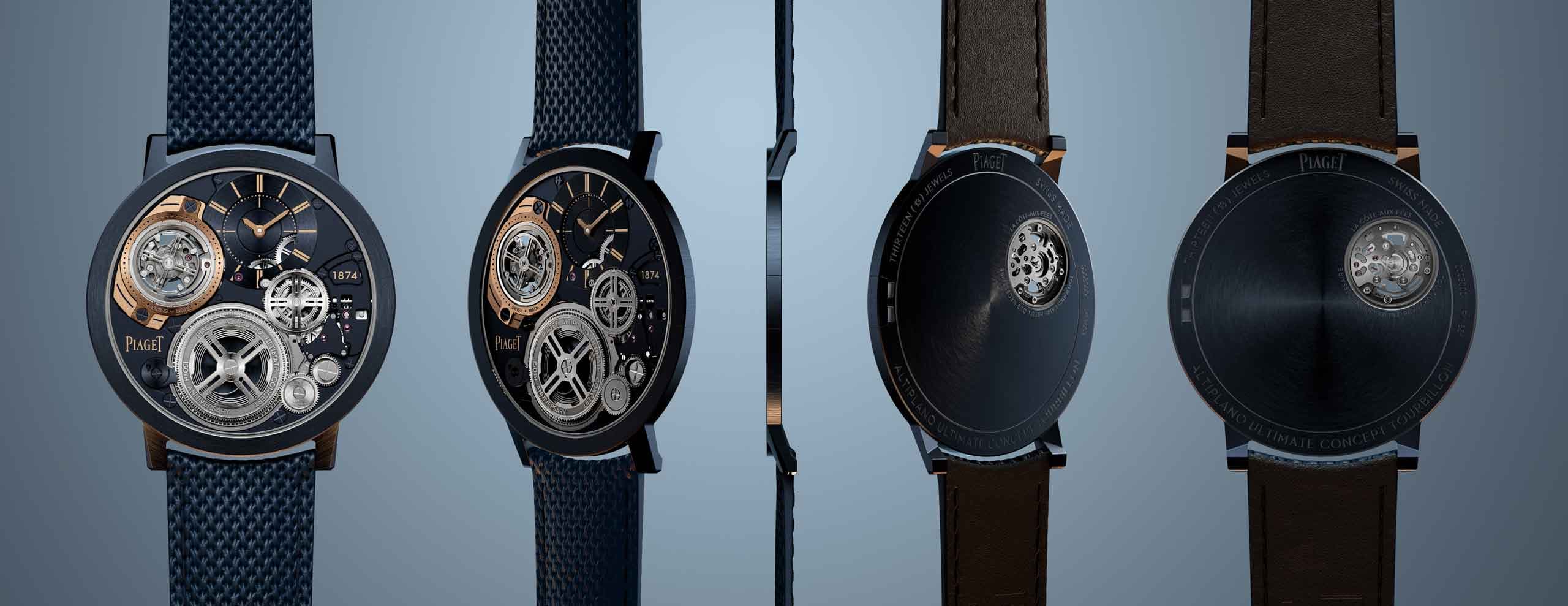
The newly released Altiplano Ultimate Concept Tourbillon is a masterclass in horological defiance. Achieving a 2mm thickness is difficult enough for a time-only watch, but incorporating a tourbillon—a rotating cage designed to counter the effects of gravity—is a feat that borders on the miraculous.
To make this work, Piaget had to redesign 90% of the original Piaget Ultimate Concept components. The tourbillon is not a traditional one; it is a peripheral version, held in place by ceramic ball bearings on its outer edges. This allows the movement to remain flat while the tourbillon dance occurs at the 10 o'clock position. The energy required to drive a tourbillon is significantly higher than a standard escapement, necessitating a redesigned mainspring and a highly efficient gear train to ensure the power reserve remains practical for daily wear.
Aesthetics and Wearability: The Ultimate Wristshot
For the enthusiast, the appeal of the Piaget Ultimate Concept isn't just in the numbers—it’s in the presence. Despite its paper-thin profile, the use of a high-tech cobalt alloy ensures the watch remains rigid. You won't find any 'case flex' here. On the wrist, the watch feels like a second skin. It disappears under a shirt cuff with ease, yet commands immediate attention the moment it catches the light.
While this isn't your rugged beater or a chunky desk diver, it possesses a structural integrity that belies its appearance. The sapphire crystal is only 0.2mm thick, yet it is engineered to withstand the pressures of daily life. The lack of traditional lume on the hands is a small trade-off for the sheer visual drama of seeing the entire gear train exposed through the dial side. Every wheel, lever, and bridge is finished to the exacting standards of Haute Horlogerie, ensuring that even under a loupe, the watch is a work of art.
Technical Specifications
| Feature | Specification |
|---|---|
| Caliber | Piaget 970P-UC (Manual Wind) |
| Case Material | Blue PVD-treated Cobalt Alloy |
| Dimensions | 41.5mm Diameter, 2.0mm Thickness |
| Water Resistance | 20 Meters (2 ATM) |
| Complications | Peripheral Tourbillon, Off-center Hours and Minutes |
| Power Reserve | Approx. 40 Hours |
| Bracelet/Strap | Ultra-thin dark blue alligator leather with Kevlar insert |
The Competition and the Title Reclaim
In the enthusiast community, debates often rage about whether these ultra-thin pieces are practical. When Richard Mille released the UP-01 at 1.75mm, it was a triumph of industrial design. When Bulgari showcased the Octo Finissimo Ultra, it was a triumph of Italian style and Swiss precision. However, Piaget’s reclaim of the 'thinnest tourbillon' title feels different. It feels like a return to the brand's core DNA.
By keeping the 2mm thickness identical to their previous time-only record holder, Piaget has demonstrated that their architecture wasn't just a one-off fluke. It was a foundation. The addition of the tourbillon adds a layer of kinetic energy to the dial that the original model lacked. Watching the cage rotate once every minute is a reminder of why we fall in love with mechanical watches in the first place—it is the triumph of gears and springs over the limitations of space.
A New Chapter in Watchmaking History
As we look at the landscape of horology in May 2024, it is clear that Piaget has set a bar that will be incredibly difficult to clear. The Piaget Ultimate Concept Tourbillon is more than just a record-breaker; it is a celebration of a century and a half of expertise. It challenges our perception of what a watch should look like and how it should feel.
For the lucky few who will add this to their collection, it represents the pinnacle of a grail watch. It is a conversation starter, a technical marvel, and a piece of history all rolled into a 2mm cobalt frame. Whether you are a fan of the ultra-thin aesthetic or a devotee of grand complications, there is no denying that Piaget has once again asserted its dominance in the world of high-end watchmaking.
The thinness wars may continue, and records may eventually fall again, but for now, the crown sits firmly in La Côte-aux-Fées. Piaget has proven that they don't just make thin watches—they make the impossible, possible.