Omega Speedmaster Calibre 321: The Ed White Return
For years, the horological community has spoken in hushed, reverent tones about a specific sequence of numbers: 321. To the uninitiated, it is merely a digit; to the enthusiast, it represents the beating heart of the most famous chronograph in history. Following the bombshell announcement last year that Omega would put the legendary movement back into production, the watch world waited with bated breath to see how it would be implemented in a non-precious metal. That wait ended last week. The Speedmaster 321 in stainless steel—affectionately dubbed the 'Ed White'—has arrived, and it is everything we hoped for.
This isn't just another heritage reissue; it is a meticulous reconstruction of a legend. By utilizing digital scanning technology to look inside the original movement used by Gene Cernan, Omega has bridged the gap between 1960s soul and 2020s precision. The result is a watch that feels like a time capsule, yet carries the weight and refinement of a modern luxury masterpiece.
The Legend of the Calibre 321
To understand why the Speedmaster 321 is causing such a stir, one must look back to the mid-20th century. The original Calibre 321 was a lateral-clutch, column-wheel chronograph movement that powered the Speedmasters that went to the Moon. It was the movement inside the ST 105.003, the very watch worn by astronaut Ed White during the first American spacewalk in 1965.
Unlike the cam-actuated 861 and 1861 movements that followed, the 321 is widely considered a work of mechanical art. Its column wheel provides a tactile, crisp engagement that many collectors consider the 'gold standard' for chronographs. When Omega ceased production of the 321 in 1968, it became an instant 'grail' for those seeking the purest expression of the Moonwatch. The return of the Speedmaster 321 in 2020 signifies a commitment to heritage that few other brands could—or would—undertake.
Design: The 'Ed White' Silhouette
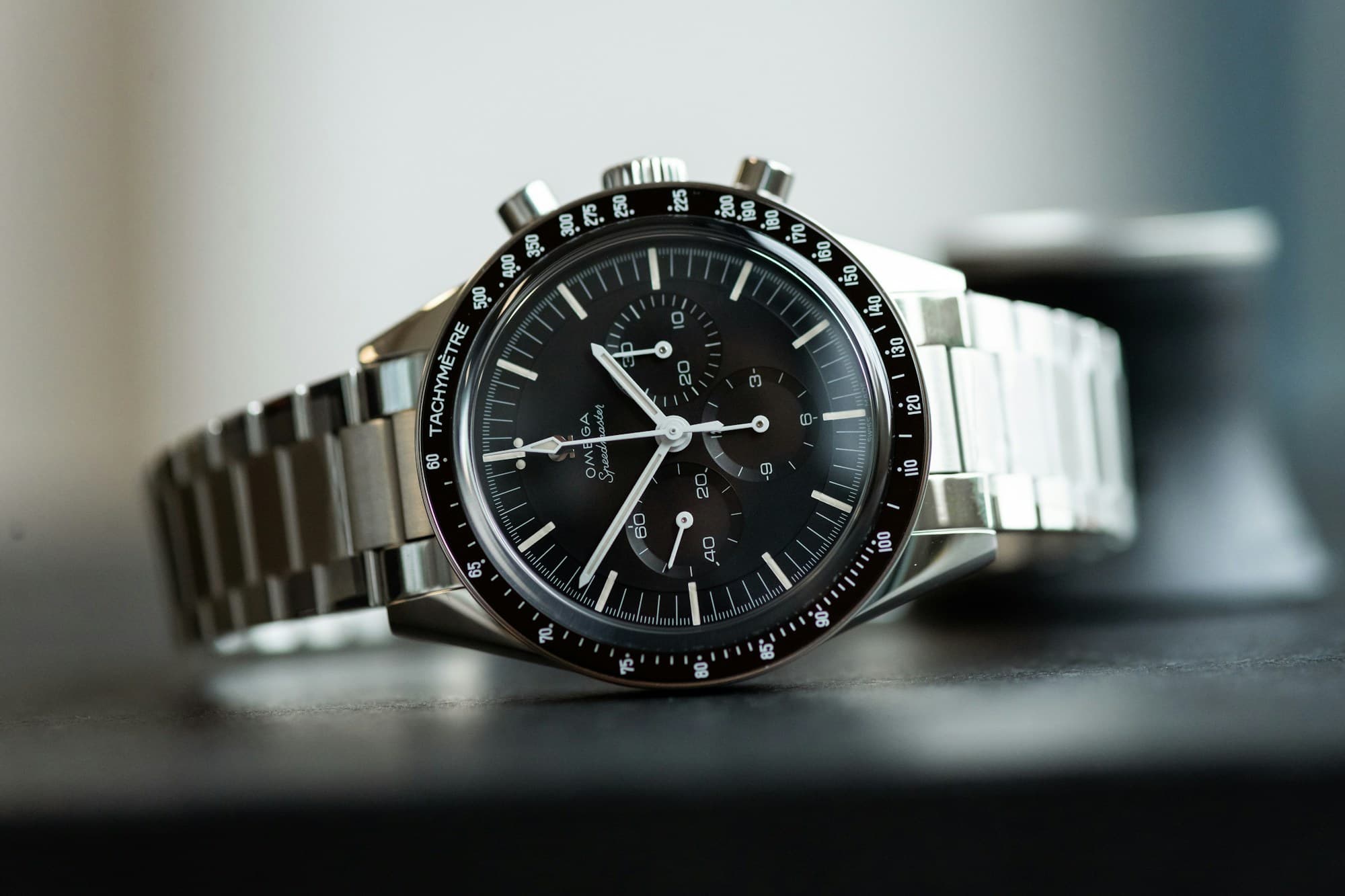
The new Speedmaster 321 (Ref. 311.30.40.30.01.001) takes its design cues directly from the 3rd generation Speedmaster, the 105.003. This means it eschews the 'Professional' twisted lugs and crown guards we’ve grown accustomed to on the standard Moonwatch. Instead, we are treated to a 39.7mm case with straight lugs, lending the watch a leaner, more vintage profile that wears beautifully on a variety of wrist sizes.
Despite the vintage dimensions, the execution is purely modern. The bezel is crafted from polished black ceramic [ZrO2], featuring a tachymeter scale in white 'Grand Feu' enamel. True to the 'Dot Over Ninety' (DON) heritage, this bezel is a love letter to the purists. Protecting the 'step' dial is a dual-arched sapphire crystal, treated with anti-reflective coating. While some might long for Hesalite to achieve that specific vintage warmth, the sapphire 'sandwich' allows for a clear view of the movement—a view no owner would want to hide.
Technical Specifications
| Feature | Specification |
|---|---|
| Caliber | Omega Calibre 321 (Manual-wind column-wheel chronograph) |
| Case Material | Stainless Steel |
| Dimensions | 39.7mm Diameter; 19mm Lug Width |
| Water Resistance | 50 Meters (5 bar) |
| Complications | Chronograph, Small Seconds, Tachymeter |
| Bracelet/Strap | Stainless steel vintage-style bracelet with foldover clasp |
| Power Reserve | 55 Hours |
| Bezel | Black Ceramic with Grand Feu Enamel scale |
Reconstructing a Masterpiece
Omega didn't just 're-release' a movement; they re-engineered it. Using 'tomography' (scanning technology) to examine the internal components of the 321 movement found in the Speedmaster worn by astronaut Eugene 'Gene' Cernan on Apollo 17, Omega ensured every dimension was historically accurate. This second-generation version of the 321 movement features a Sedna™ gold PVD finish, providing a striking contrast against the steel case.
When you wind the Speedmaster 321, the sensation is noticeably different from the 1861. It is smoother, more deliberate. Engaging the pusher results in a sharp 'click' that reminds the wearer of the mechanical complexity at play. This isn't a 'beater' watch intended for yard work; it is a piece of horological history reborn for the modern era.
On the Wrist: The Ultimate Grail?
Sliding the Speedmaster 321 onto the wrist, the first thing you notice is the bracelet. It is a vintage-inspired flat-link design that is much thinner and more articulated than the chunky bracelets found on modern Professionals. It drapes across the wrist with a comfort that rivals the best luxury sports watches on the market.
In a world of 'desk divers' and oversized chronographs, the 39.7mm proportions of the 'Ed White' feel like a return to form. It has a presence that is understated yet undeniable. The lume, while modern Super-LumiNova, has been applied in a way that mimics the look of aged tritium, giving it a slight 'patina' feel without the fragility of a 50-year-old dial. Taking a wristshot of this piece under natural light reveals the depth of the step dial and the way the ceramic bezel catches the sun—it is, quite simply, a photogenic masterpiece.
Conclusion
The release of the Speedmaster 321 in stainless steel represents a landmark moment for Omega and for watch collecting as a whole. By bringing back the column-wheel 321 movement and housing it in the historically significant 105.003 case, Omega has created a bridge between the heroic era of space exploration and modern watchmaking excellence.
While the price point sits significantly higher than the standard Moonwatch, and the production numbers will be limited by the sheer complexity of the movement assembly (which is performed in a dedicated Calibre 321 workshop), the value proposition for a true enthusiast is clear. This is not just a watch; it is the soul of the Moonwatch returned to us in its purest form. Whether you are a lifelong Speedmaster devotee or a newcomer looking for that one 'grail' piece to define a collection, the new Speedmaster 321 is a triumph of heritage and engineering.