Lubricant-Free Escapements: Technical Break-through
For centuries, the greatest enemy of the mechanical watch has not been water, magnetism, or even the occasional accidental drop against a marble floor. Instead, it has been the silent, microscopic war of attrition known as friction. Since the days of Abraham-Louis Breguet, watchmakers have relied on animal, vegetable, and eventually synthetic oils to keep gears turning. However, as of October 2025, we have officially entered a new era where the lubricant free watch movement is no longer a niche experimental concept, but the gold standard for high-end chronometry. By eliminating the need for traditional oils in the escapement, brands are finally solving the problem of lubricant degradation, which has historically been the primary driver for the dreaded five-year service interval.
The Arch-Nemesis of Horology: Why Lubrication Fails
In a traditional movement, the pallet stones strike the escape wheel teeth thousands of times per hour. To prevent the metal-on-metal contact from grinding the components into dust, a tiny droplet of Moebius oil is applied to each tooth. Over time, this oil dries out, migrates, or thickens into a sticky paste—a process enthusiasts often refer to as "gumming up."
When the oil loses its viscosity, the amplitude of the balance wheel drops, and the watch loses its ability to keep consistent time. This is why even your most prized grail watch eventually needs to be sent back to the manufacture. The quest for a lubricant free watch movement is essentially the quest for the "forever watch"—a caliber that maintains its factory-spec chronometric precision for decades rather than years.
The Silicon Revolution: Paving the Way
The transition toward frictionless horology began in earnest with the introduction of silicon (or Silicium). Unlike traditional steel or brass, silicon is incredibly hard, lightweight, and—most importantly—self-lubricating. When Ulysse Nardin released the original Freak in 2001, it sent shockwaves through the industry by utilizing silicon for its escapement wheels.
By 2025, the technology has matured significantly. We are now seeing the widespread use of DRIE (Deep Reactive Ion Etching) to create complex, multi-level components that were previously impossible to manufacture. These parts are so smooth at a molecular level that the friction coefficient is negligible, allowing for a lubricant free watch movement that performs flawlessly without a single drop of oil on the pallet forks.
Beyond Silicon: DiamonSil and Carbon Coatings
While silicon was the first step, the industry has pushed further into "DiamonSil"—a combination of silicon and synthetic diamond. By growing a layer of polycrystalline diamond over a silicon core, watchmakers have created components that are virtually indestructible. This technology, perfected in the Ulysse Nardin Freak collection, ensures that the surfaces sliding against one another are so hard that wear is non-existent. For the collector looking for a desk diver that can survive the rigors of daily wear without losing a beat, this technical breakthrough is a game-changer.
Case Study: The Ulysse Nardin Freak S Nomad (2025 Edition)
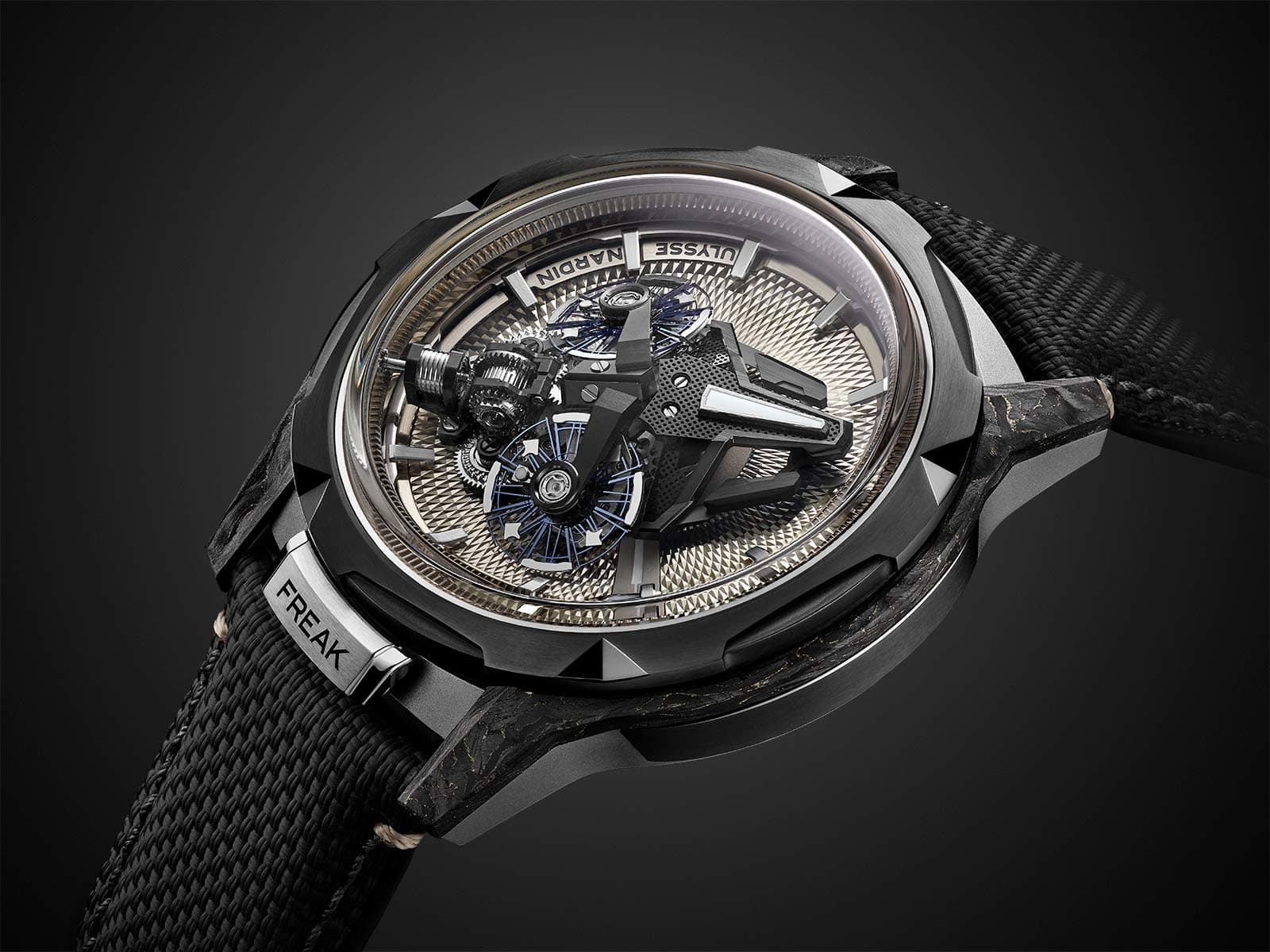
The Freak S Nomad represents the pinnacle of this movement. It doesn't just look like a spaceship for the wrist; it functions like one. The caliber UN-251 features a double oscillator in silicon, connected by a differential. Because the entire escapement is crafted from diamond-coated silicon, it stands as a premier example of a modern lubricant free watch movement.
| Feature | Specification |
|---|---|
| Caliber | Manufacture Caliber UN-251 (Automatic) |
| Escapement | Grinder® high-efficiency winding system, Diamond-coated Silicon |
| Case Material | Titanium with Anthracite PVD coating and Carbon Fiber side plates |
| Dimensions | 45mm Diameter, 13.5mm Thickness |
| Water Resistance | 30 Meters (3 ATM) |
| Complications | Flying Carousel with Double Silicon Oscillators, Differential |
| Bracelet/Strap | Integrated rubber-effect leather strap with folding clasp |
The Impact on Service Intervals and Longevity
One of the most exciting aspects of the lubricant free watch movement for the average enthusiast is the extension of service intervals. In the past, the "five-year rule" was dictated by the lifespan of the oils. With diamond-coated silicon components, the mechanical heart of the watch can theoretically beat for twenty years without physical wear.
While you might still need to service the gaskets for water resistance or check the winding rotors, the core timekeeping mechanism remains pristine. This also means that these modern pieces won't develop the "patina" of age in their movement—they will look as clean in fifty years as they do on the day of the first wristshot. For many, this reliability makes the high entry price of such technology feel like a sound investment.
High-Frequency and Monolithic Oscillators
We cannot discuss the lubricant free watch movement without mentioning Zenith’s contributions. Their Monolithic oscillator, which replaces the traditional 30-plus parts of a standard escapement with a single silicon element, vibrates at a staggering 15Hz. Because there are no separate parts hitting each other—only a single piece of silicon flexing—there is no friction to manage. This isn't just a technical breakthrough; it's a complete reimagining of how a watch stores and releases energy.
While some purists miss the traditional "tick-tock" sound of a Swiss lever escapement, the performance benefits are undeniable. The stability of the lume on a dial is easy to see, but the stability of a 15Hz silicon oscillator is something you feel in the incredible accuracy of the piece, often varying by less than half a second per day.
The Future of Frictionless Timekeeping
As we look toward the end of 2025 and into 2026, the challenge for the industry is democratization. Currently, a lubricant free watch movement is typically reserved for high-end pieces from the likes of Girard-Perregaux, Patek Philippe, and Ulysse Nardin. However, as manufacturing costs for silicon and carbon-coating processes continue to drop, we expect to see this technology trickle down into more accessible "beater" watches.
Imagine a world where even an entry-level mechanical watch requires no oil and maintains COSC-level accuracy for a decade. We are not quite there yet for the mass market, but the technical breakthroughs of the last few years have proven that the "oil-free" dream is no longer a fantasy. The mechanical watch is evolving from a delicate instrument that requires constant nursing into a robust, high-tech machine that can truly last a lifetime.
Conclusion
The shift toward the lubricant free watch movement represents one of the most significant leaps in horological history since the invention of the quartz crystal. By leveraging the power of silicon, diamond coatings, and monolithic architectures, watchmakers are finally overcoming the physical limitations of friction. For the collector, this means more time on the wrist and less time at the service center. Whether you are hunting for your next grail or looking for a technologically superior desk diver, the elimination of lubricants is a breakthrough that ensures our mechanical treasures will keep ticking long into the future.