Longines Heritage Classic: The Sector Dial Trend
In the ever-evolving landscape of horology, few aesthetics have captured the imagination of modern collectors quite like sector dial watches. While the industry often oscillates between the rugged utility of the modern 'desk diver' and the high-octane flash of integrated-bracelet sports watches, there is a growing movement toward the refined, scientific elegance of the 1930s. Leading this charge is the Longines Heritage Classic, a timepiece that has quickly ascended to 'grail' status for those seeking vintage charm without the mechanical headaches of a sixty-year-old movement. Today, we explore why this specific design language is resonating so deeply with the community and how Longines managed to capture lightning in a bottle.
The Resurgence of Sector Dial Watches
To understand the appeal of the Longines Heritage Classic, one must first understand the DNA of sector dial watches. Originally rising to prominence in the late 1920s and 1930s, the sector dial—sometimes referred to as a 'scientific' dial—was designed with legibility and precision in mind. These dials are characterized by a central 'crosshair' and concentric circles that divide the dial into distinct sectors for hours and minutes.
In an era before computer-aided design, these markings served a functional purpose for professionals who required precise time-tracking. Fast forward to 2020, and the appeal is purely aesthetic. There is a mathematical harmony to a well-executed sector dial that feels both disciplined and artistic. While brands like Patek Philippe and Jaeger-LeCoultre have recently dipped their toes back into these waters, Longines has brought the look to a much broader audience, proving that you don't need to spend five figures to own a piece of horological history.
The Longines Heritage Classic: A Closer Look
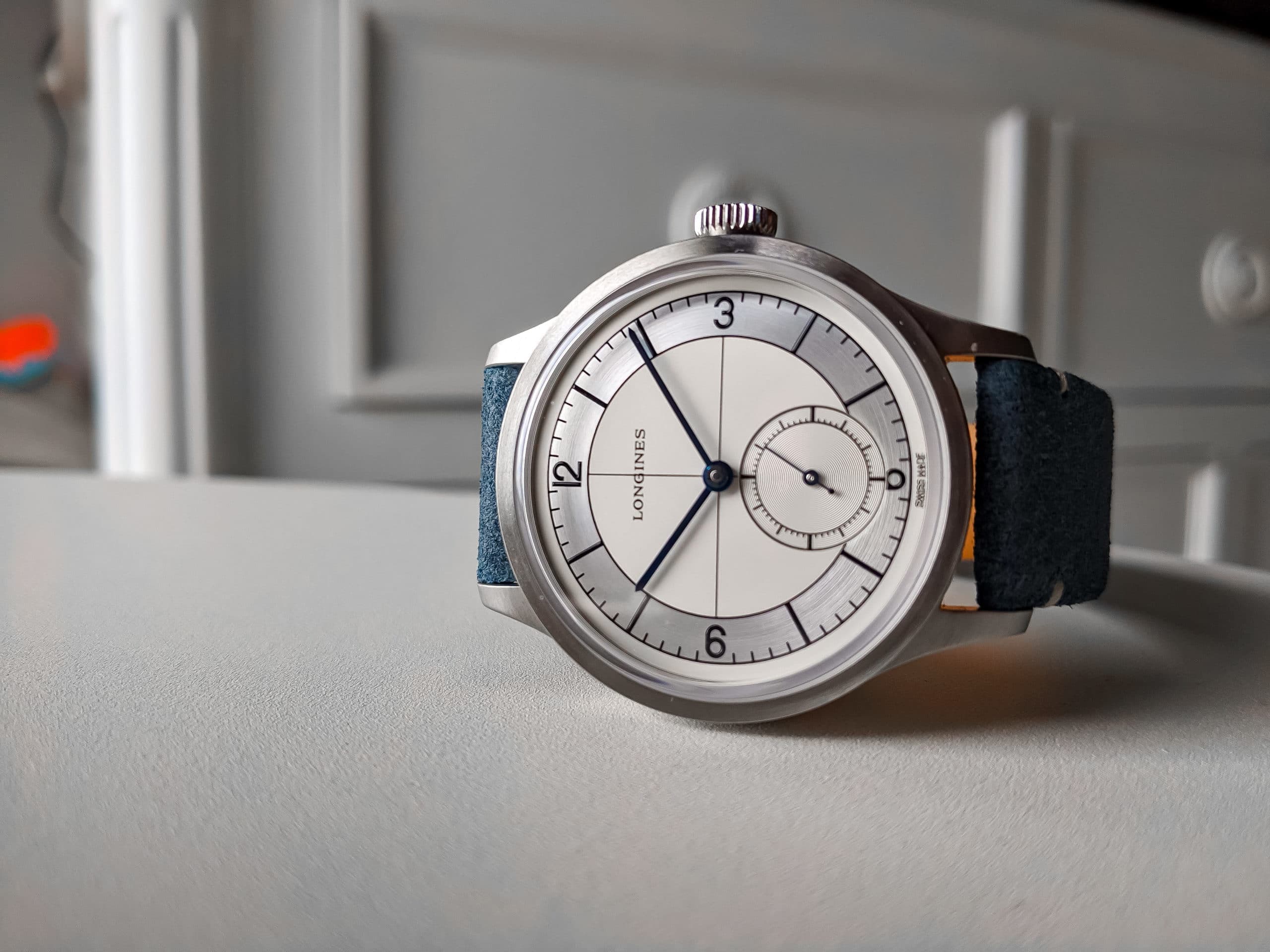
When Longines announced the Heritage Classic (Ref. L2.828.4.73.0), the enthusiast community collectively exhaled a sigh of relief. Why? Because Longines listened. For years, collectors have bemoaned the inclusion of date windows on heritage re-issues, which often ruin the symmetry of a vintage-inspired dial. By opting for a 'no-date' configuration, Longines preserved the purity of the 1930s design.
Dial Aesthetics and Finishing
The dial is the undisputed star of the show. It features a two-tone silver finish that plays beautifully with the light. The central disk has a subtle matte finish, while the outer ring, which houses the Arabic numerals and hour markers, features a circular brushed finish. This contrast creates a dynamic 'wristshot' experience; in some lighting, the sectors appear starkly different, while in others, they blend into a cohesive, silvery glow.
Adding to the vintage allure are the blued steel hands. These aren't just painted blue; they are thermally treated, providing a deep, ink-like hue that flashes bright cobalt when the sun hits them. The 'small seconds' sub-dial at 6 o'clock is slightly recessed and features a concentric 'azurage' pattern, adding a layer of texture that many watches at this price point lack.
Technical Specifications
Under the hood, Longines has utilized a modern powerhouse that ensures this watch can serve as a reliable daily wearer rather than a delicate safe queen. Here are the detailed specifications for the Longines Heritage Classic:
| Feature | Specification |
|---|---|
| Reference Number | L2.828.4.73.0 |
| Caliber | Longines L893 (Automatic, ETA A31.501 base) |
| Case Material | Stainless Steel |
| Dimensions | 38.5mm Diameter; 11mm Thickness; 19mm Lug Width |
| Power Reserve | Approximately 64 hours |
| Water Resistance | 3 bar (30 meters) |
| Complications | Small seconds at 6 o'clock (No-date) |
| Crystal | Scratch-resistant sapphire with multilayer anti-reflective coating |
| Bracelet/Strap | Blue or black leather with additional NATO-style strap |
The Movement: Caliber L893
The choice of the Caliber L893 is a significant nod to the enthusiast crowd. Based on the ETA A31.501, this movement was developed exclusively for Longines’ Heritage line. The key feature here is the relocation of the seconds hand pinion. By moving the small seconds lower on the dial, Longines avoided the 'squinting' look of many modern watches where the sub-dial feels too close to the center of the face. This architectural adjustment allows the proportions of the Heritage Classic to mimic its 1930s ancestors almost perfectly.
Furthermore, with a 64-hour power reserve and a beat rate of 25,200 vph, it strikes a balance between modern reliability and the slower, more soulful sweep of a vintage caliber. While it lacks the 'patina' of an original 12.68Z movement, it offers the peace of mind that only a modern warranty can provide.
On the Wrist: Proportions and Versatility
At 38.5mm, the Longines Heritage Classic sits in the 'Goldilocks' zone of watch sizing. It is large enough to feel contemporary on a modern wrist but small enough to retain the elegance of a dress watch. The 11mm thickness allows it to slide effortlessly under a shirt cuff, making it an ideal companion for formal attire. However, don't let its dressy DNA fool you.
One of the joys of sector dial watches is their versatility. When swapped from the provided blue leather strap to a distressed tan nubuck or even a 'beads of rice' bracelet, the character of the watch shifts. It becomes more casual, more tool-like—something that wouldn't look out of place with a denim jacket and boots. While it’s certainly not a 'beater' intended for the gym or a rugged hike, it handles the rigors of the 'office adventurer' with ease.
The Cultural Impact of the Sector Dial
Why are we so obsessed with these designs in 2020? Perhaps it is a reaction to the digital saturation of our lives. A sector dial represents a time when timekeeping was a physical, mechanical, and scientific endeavor. There is something comforting about the rigid geometry of the sectors. It feels like an instrument of navigation from a bygone era of exploration.
In the current market, the Longines Heritage Classic stands as a formidable competitor to other sector dial watches. While the Jaeger-LeCoultre Master Control Date (released in 2017) brought the sector dial back into the mainstream consciousness, its higher price point and date window left a gap in the market. Longines has filled that gap perfectly, offering a watch that feels premium, looks historical, and remains accessible to the burgeoning collector.
Final Thoughts
The Longines Heritage Classic is more than just a successful re-issue; it is a testament to the enduring power of thoughtful design. By focusing on the nuances—the brushed finishes, the blued steel hands, and the removal of the date window—Longines has created a timepiece that transcends the 'trend' of sector dial watches and becomes a modern classic in its own right.
Whether you are a seasoned collector with a box full of 'grails' or a newcomer looking for your first serious mechanical watch, the Heritage Classic offers a compelling narrative. It bridges the gap between the heritage of the 1930s and the manufacturing excellence of 2020, proving that sometimes, looking backward is the best way to move the industry forward.