3D-Printed Titanium: Apiar and Holthinrichs
For decades, the high-end watch industry was defined by the subtractive: blocks of steel or gold painstakingly milled, turned, and polished into form. However, as we cross into the mid-2020s, a new paradigm has taken hold, shifting the focus from what we can take away to what we can build from the ground up. The 3D printed titanium watch has evolved from a niche experimental curiosity into a legitimate pillar of independent haute horlogerie. Leading this charge are two brands with distinct philosophies but a shared medium: the British-based Apiar and the Dutch architectural powerhouse Holthinrichs. Today, we explore how these two trailblazers are using additive manufacturing to create timepieces that were previously considered physically impossible to manufacture.
The Technical Edge: Why 3D Printed Titanium?
To understand the allure of a 3D printed titanium watch, one must first understand the limitations of traditional CNC machining. Grade 5 titanium is notoriously difficult to work with; its toughness ruins drill bits, and its tendency to gall makes intricate internal geometries a nightmare for traditional lathes.
Additive manufacturing—specifically Laser Powder Bed Fusion (LPBF)—allows Apiar and Holthinrichs to grow a case layer by layer using a high-powered laser to fuse titanium powder. This process enables "generative design," where internal lattices and organic, hollowed-out structures can be integrated directly into the case. The result is a watch that is significantly lighter than its solid-milled counterparts while maintaining—or even exceeding—structural integrity. For the enthusiast searching for their next grail, this represents the ultimate marriage of material science and aesthetics.
Apiar: British Engineering and the Invenio
Based in the UK, Apiar has quickly made a name for itself by leaning into the engineering potential of additive manufacturing. Their flagship model, the Invenio, is a masterclass in how a 3D printed titanium watch can look both futuristic and grounded in classic proportions.
Apiar’s design language is heavily influenced by the aerospace and high-performance automotive industries. The Invenio features a complex, multi-part case construction where the lugs and mid-case boast a porous, honeycomb-like geometry. This isn't just for show; it reduces the weight on the wrist to almost nothing, making it a candidate for the ultimate daily wearer—even if you're just a "desk diver" at heart. The texture of the raw 3D-printed titanium is often left slightly tactile in the recessed areas, providing a beautiful contrast to the hand-finished, polished bevels that catch the light during a midday wristshot.
Apiar Invenio Technical Specifications
| Feature | Specification |
|---|---|
| Caliber | Sellita SW200-1 (Bespoke finishing) |
| Case Material | 3D Printed Ti-6Al-4V Titanium |
| Dimensions | 39mm Diameter, 12.5mm Thickness |
| Water Resistance | 100 Meters |
| Complications | Three-hand time only |
| Bracelet/Strap | Integrated textile or premium leather |
Holthinrichs: Architectural Minimalism and the Deconstructed
While Apiar focuses on the engineering prowess of the 3D printed titanium watch, Michiel Holthinrichs brings an architect’s eye to the bench. Based in Delft, Holthinrichs Watches has been a pioneer in this space since 2016, but their 2024 and early 2025 releases have pushed the envelope even further.
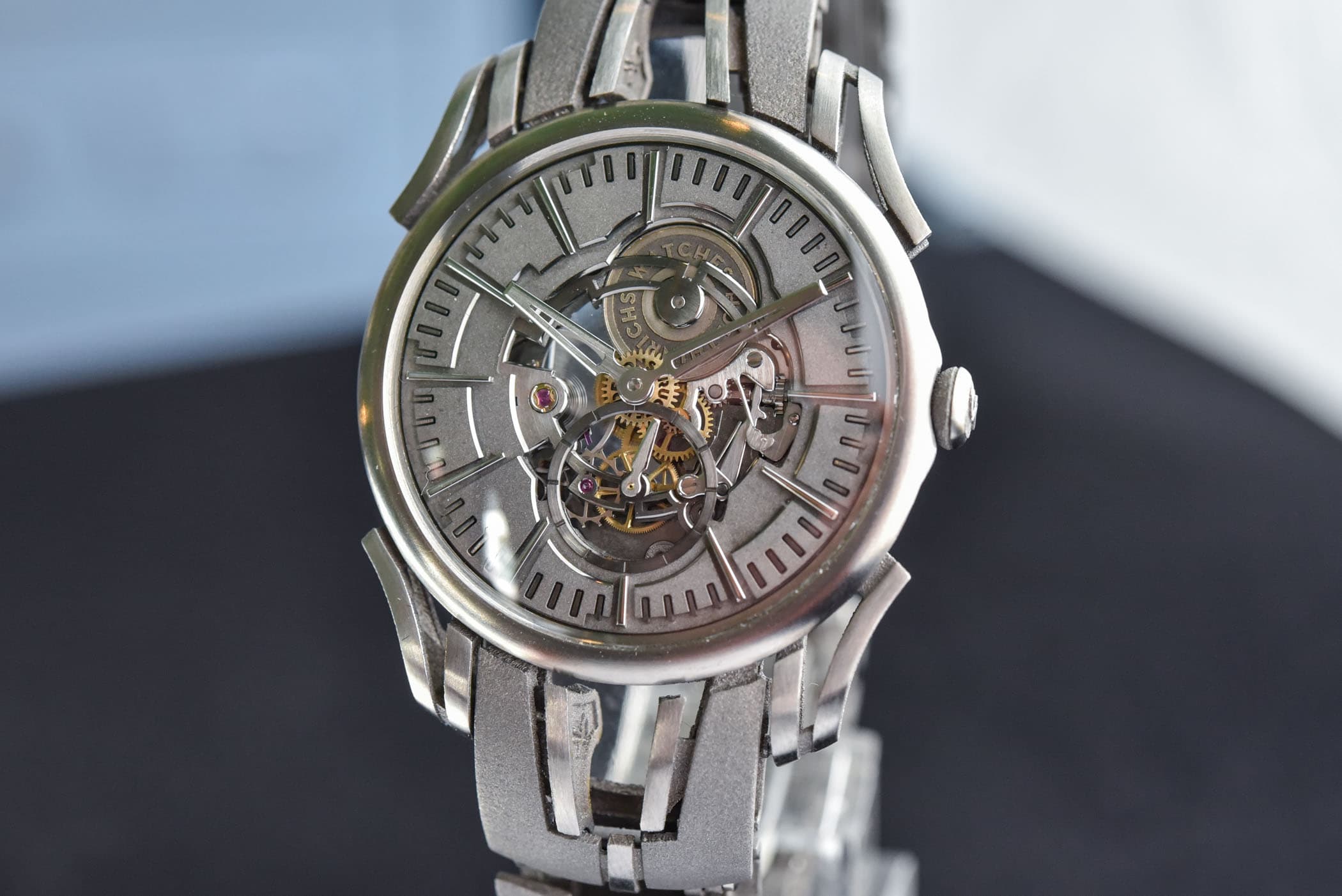
Holthinrichs utilizes 3D printing to create "skeletal" cases. The Deconstructed series, for instance, features lugs that are entirely hollow, resembling the flying buttresses of a gothic cathedral. Because the titanium is grown rather than cut, Holthinrichs can create concave surfaces and sharp interior angles that a CNC milling head simply couldn't reach.
What sets Holthinrichs apart is the level of post-processing. Each 3D printed titanium watch undergoes hours of hand-refinement. The raw, "as-printed" texture is utilized as a design element—often found in the deep crevices of the case—while the visible surfaces are polished to a mirror shine or given a deep, satiny brush. This creates a "patina" of textures that play with shadow in a way traditional watches cannot.
Holthinrichs Deconstructed Technical Specifications
| Feature | Specification |
|---|---|
| Caliber | HW-M01 (Manual wind, highly modified) |
| Case Material | 3D Printed Grade 5 Titanium |
| Dimensions | 38.5mm Diameter, 9.8mm Thickness |
| Water Resistance | 30 Meters |
| Complications | Small seconds at 6 o'clock |
| Bracelet/Strap | Handmade alligator or tapered titanium mesh |
The Evolution of the Wearing Experience
For the modern collector, the appeal of a 3D printed titanium watch goes beyond the specs. It is about the "wearing experience." Because these cases can be designed with hollowed-out sections, the center of gravity is often lower and more centered on the wrist.
Furthermore, the design freedom allows for better integration of the lume and dial elements. Apiar, for example, uses the 3D printing process to create unique dial textures that mimic the case's lattice structure, ensuring a cohesive design language from the crystal down to the caseback. In the dark, the glow of the Super-LumiNova against the matte grey of the titanium creates a high-contrast look that is quintessentially modern.
There is also the element of exclusivity. While these brands aren't producing "one-offs" in the traditional sense, the nature of additive manufacturing allows for small-batch iterations. If a design needs a 0.5mm adjustment for better ergonomics, it doesn't require a total overhaul of a factory's tooling—just a tweak to the digital CAD file. This agility is why the 3D printed titanium watch is currently the playground of the most exciting independent watchmakers.
The Future of Additive Horology
As we look ahead through 2025, the question is no longer if 3D printing belongs in luxury watchmaking, but how far it can go. We are already seeing experiments with 3D-printed precious metals and even printed ceramic components. However, titanium remains the gold standard for this technology due to its strength-to-weight ratio and its biocompatibility.
Whether you are drawn to the rugged, British engineering of Apiar or the sculptural, Dutch minimalism of Holthinrichs, owning a 3D printed titanium watch is about owning a piece of the future. These aren't just tools for telling time; they are wearable sculptures that challenge our understanding of how objects are made.
For those who appreciate the "heritage" part of our name, it’s worth noting that both brands still rely heavily on traditional watchmaking skills. The movements are hand-regulated, the cases are hand-finished, and the assembly is done by master watchmakers. The 3D printer is simply a new chisel in the artisan's kit, allowing them to carve shapes that were once only possible in our dreams.
In conclusion, the rise of Apiar and Holthinrichs marks a significant turning point. By embracing the 3D printed titanium watch, these brands have moved past the novelty phase and into a new era of structural innovation. If you have the opportunity to handle one of these pieces at a local RedBar meet or a boutique, do not pass it up. The weight—or lack thereof—and the intricate play of light across the printed surfaces must be seen in person to be truly appreciated. The future of the grail watch is here, and it is being built one layer of titanium powder at a time.